When you buy imported dates, the "country of origin" label is more than geographic detail — it is a clue to quality, fair price range, and the character of the fruit you will receive. From an importer's viewpoint, each origin has its own "signature": a physical profile, a value-per-kilogram position in the import market, and a distinct quality reputation. This article is not a variety guide but a sourcing brief: how to recognise a date's origin from its traits, understand why prices differ so widely between countries, and verify that a claimed origin makes sense. The aim is to help you buy with an importer's eye, not merely follow the label.
The Import Value Map: Why Prices Differ Between Countries
Import data reveals an interesting gap between volume and value. In 2025, Indonesia imported around 54,452 tons of dates worth roughly USD 68 million (Statistics Indonesia data cited by economic media). What is striking is how value per kilogram differs sharply between origins — a reflection of each one's quality tier and market position.
| Country of Origin | 2025 Volume (t) | 2025 Value (USD) | Value-per-Kg Indication | Market Position |
|---|---|---|---|---|
| Egypt | ±24,232 | ±22.4M | Lowest (~USD 0.9/kg) | Volume driver, value segment |
| Saudi Arabia | ±11,511 | ±13.05M | Medium (~USD 1.1/kg) | Diverse varieties, mid-premium |
| UAE | ±7,650 | ±10.04M | Medium (~USD 1.3/kg) | Mid-value segment |
| Tunisia | ±3,292 | ±9.79M | High (~USD 3/kg) | Value premium (Deglet Nour) |
| Palestine | ±418 | ±2.39M | Highest (~USD 5.7/kg) | Top premium (Medjool) |
The value-per-kg figures above are rough estimates from dividing value by volume, not retail selling prices. But the pattern is informative: Egypt dominates volume as the value source, while Palestine, despite small volume, holds the highest value per kilogram — underscoring its premium tier. Understanding this map helps you judge whether an offered price is reasonable for a given origin.
The Physical Signature of Each Origin
Although the most reliable verification is still via label and documents, physical traits help you read a date's origin. Here is a general picture (not an absolute rule, since each country has many varieties):
Egypt
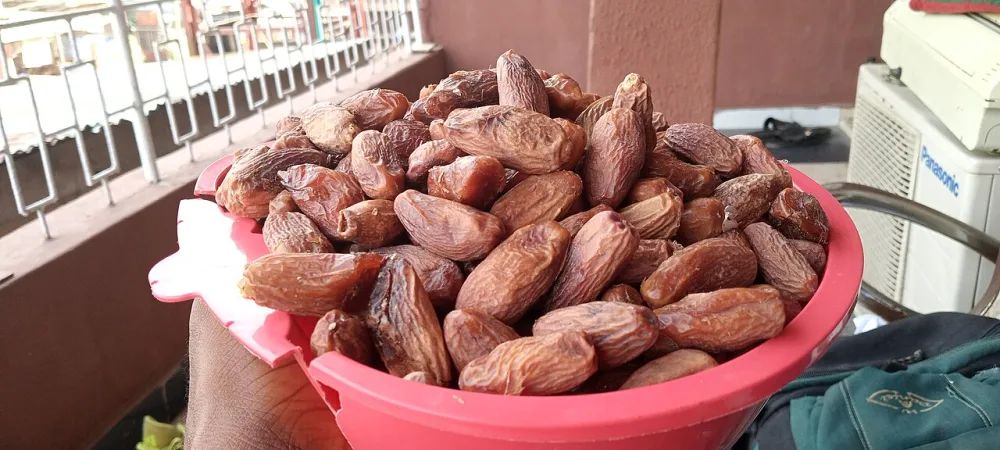
Egyptian dates, including those known as Golden Valley, tend to be lighter to golden in colour with a texture that can be more moist, and their price is the most affordable. This is the backbone of the volume market.
Saudi Arabia
The source of iconic varieties such as Ajwa (dark, soft, from Madinah), Sukari (sweet, from Al Qassim), and Safawi (dark). Its quality range is wide, from everyday to premium.
Tunisia
Synonymous with Deglet Nour — the "date of light" with a soft texture, often sold on the branch to highlight appearance. Its value per kilogram is high, reflecting a premium position.
Iran
Famous for wet Mazafati (rotab Bam) that is dark, soft, and high in moisture, as well as Mariami/Piarom. This wet character is what demands cold-chain handling.
Palestine
The source of large premium Medjool — the "king of dates" — with the highest value per kilogram among major sources. Its import volume is small but highly sought after.
From a Bulk Buyer's View: Matching Origin to Need
For resellers, shop owners, and institutional procurement, understanding the origin map is not mere knowledge but a decision tool. Each origin suits a different need. For mass takjil or volume raw material where price is the priority, dates from a volume source like Egypt often make the most economic sense. For a customer segment that prioritises appearance and soft texture, Tunisian Deglet Nour or premium Medjool offers a different selling point. For a market chasing religious nuance and distinction, Madinah varieties such as Ajwa and Safawi hold their own appeal.
A mature approach is to compose an origin mix matched to the customer profile, rather than relying on a single source. An importer with a cross-country portfolio makes this strategy easier because buyers can access diverse tiers from one supply point. It also reduces risk: when one origin faces supply disruption or a price spike, another can serve as an alternative. Origin diversification, then, is not only about flavour variety but also procurement resilience.
The Link Between Origin, Grade, and Price
The country of origin determines variety availability, while grade determines the quality position within a variety. A grading system — such as Standard, Premium, up to VIP or VVIP Jumbo — sorts dates by size, uniformity, and condition. Hence two dates from the same origin can differ greatly in price depending on grade. When assessing an offer, watch all three layers of information at once: origin (source and reputation), variety (fruit type), and grade (quality within the variety). A transparent offer usually states all three clearly, while a vague offer tends to highlight only a low price without explaining what you are actually buying.
Verifying a Claimed Origin
Sellers can be mistaken or deliberately blend information. Some ways to verify origin:
- Match the variety to the country. If a product is claimed as "Ajwa" but the origin is not Saudi Arabia, that is odd. Likewise, Deglet Nour should be synonymous with Tunisia/related regions.
- Check the country-of-origin label. Look for explicit text or a country code on official packaging.
- Compare price against the value map. A "premium" price for a variety that should be value-tier, or a very cheap price for a premium variety, are both worth questioning.
- Ask the supplier. Direct importers usually know the grove of origin and import route; vague answers are a signal.
As a direct importer with a cross-country portfolio — Egypt, Saudi Arabia, Tunisia, Iran, and Palestine — we provide variety and grade guides so buyers can match quality expectations with origin and price. To ask about the availability of a specific origin, contact our team via WhatsApp.
Note: import value figures come from public BPS data cited by media and are indicative; the value-per-kilogram here is a rough calculation for illustration, not a selling price. This information is educational to aid decision-making, not an official quotation.